
One evening, my son was playing on our street when he started digging into the soil.
He dug, and dug, and dug. Then he looked up at me, full of curiosity, and the questions came pouring out:
“Appa, what is inside this?”
“How long can I keep digging?”
“What is there, deep down?”
What wonderful questions! They’re the same questions real scientists ask. So I decided to find the answers and write them down, for him and for every curious child like him.
And now I’m inviting you to come along too. Put on your explorer hat, pick up your imaginary spade, and let’s dig down through the layers of soil!
Soil Is Like a Layer Cake
Have you ever seen a cake with different layers stacked on top of each other? Soil is just like that! If you could cut the ground open like a cake, you’d see five layers, each one a different colour.
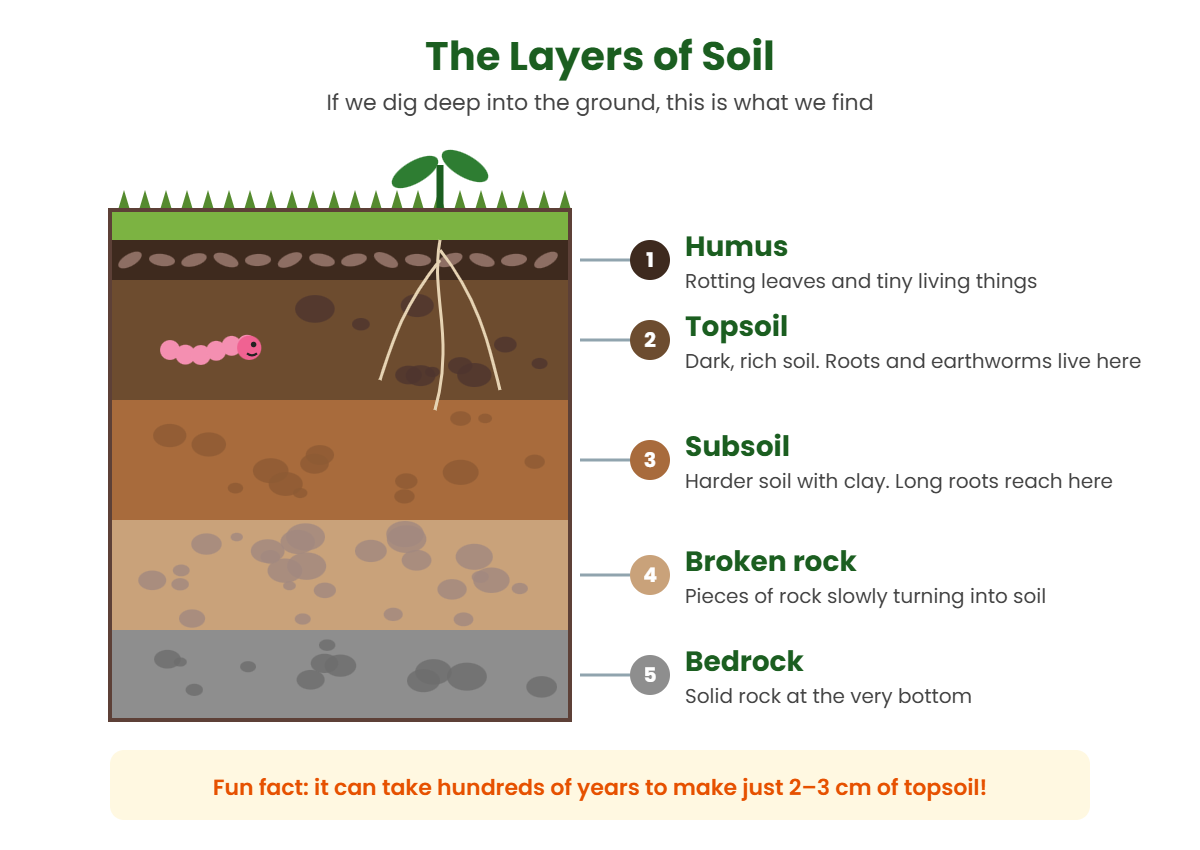
Ready? Let’s start digging from the top.
Stop 1: Humus, the Leaf Blanket 🍂
Our spade first touches a thin, dark layer made of fallen leaves and twigs. This is called humus (say it: hyoo-mus).
Tiny helpers like bugs and fungi slowly munch these leaves into plant food. Humus is like a warm blanket that keeps the soil moist and fed.
Stop 2: Topsoil, the Busy Town 🐛
A little deeper, the soil turns dark brown and soft. This is topsoil, the busiest layer of all!
Most plant roots live here. So do earthworms, wriggling around making tiny tunnels. Those tunnels let air and water reach the roots. Earthworms are the soil’s little gardeners!
Stop 3: Subsoil, the Storeroom 🧱
Now digging gets harder. The soil is lighter, often reddish, and a bit sticky. This is subsoil.
It’s full of minerals, which are like vitamins for plants. Only big trees with long roots can reach down here.
Stop 4: Broken Rock 🪨
Clink! Our spade hits pieces of broken rock. Over many, many years, sun and rain slowly crack these rocks into smaller and smaller bits. One day, they’ll turn into soil too!
Stop 5: Bedrock, the Floor ⛰️
Finally, we reach solid rock that’s far too hard to dig. This is bedrock, the strong floor that holds up all the other layers.
So, to answer my son’s question, “How long can I keep digging?”: until you hit bedrock! 😄
Soil Takes a Very, Very Long Time to Make
Here’s something amazing. Soil is made super slowly. First, rocks get broken into tiny bits. Then leaves and old plants mix in. Worms and tiny creatures stir it all up.
It can take hundreds of years to make just 2–3 centimetres of topsoil. That’s about the width of your finger! That’s why soil is precious, and why we should take care of it.
Let’s Build Soil Layers in a Jar!
Now it’s your turn to be a soil scientist. Ask a grown-up to help, and let’s make our own layer cake of soil in a jar. It takes just 15 minutes.
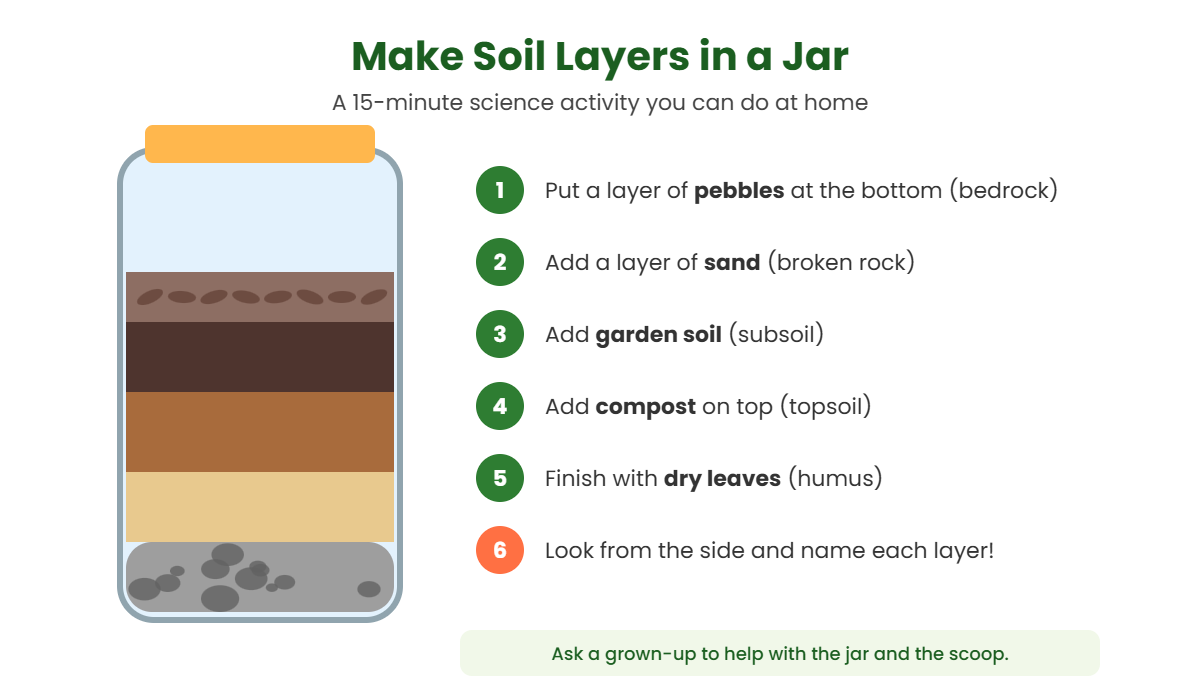
You’ll need: a clear jar, pebbles, sand, garden soil, compost, some dry leaves, and a spoon.
Now build it from the bottom up:
- Pebbles first. That’s your bedrock.
- Sand next. That’s your broken rock.
- Garden soil. That’s your subsoil.
- Compost. That’s your topsoil.
- Dry leaves on top. That’s your humus!
- Now look at your jar from the side. Can you name all five layers?
Bonus challenge: Push a bean seed just under the compost, water it gently, and watch it for a week. Where do the roots go?
Quick Quiz! 🧠
- Which layer is made of rotting leaves? (Humus!)
- Where do earthworms love to live? (Topsoil!)
- What’s the hard rock at the very bottom called? (Bedrock!)
- Is soil made fast or slow? (Very, very slow!)
A Note for Parents and Teachers
Children remember what they touch and see. Let them feel sand, clay, and compost and describe each one: gritty, sticky, or soft. On a walk, point out soil layers on the side of a dug pit or road cutting, from a safe distance. And if you’re a gardener yourself, read my guide on making the right soil mix for your terrace garden.
Little Questions, Big Answers
How many layers of soil are there?
For kids, there are five main layers: humus, topsoil, subsoil, broken rock, and bedrock.
Which layer is best for plants?
Topsoil! It’s soft, rich, and full of food and tiny living things.
Why are earthworms good for soil?
They dig tunnels that let in air and water, and their poop is great plant food!
Keep Exploring, Little Scientist!
So the next time you’re in a garden or park, look down at your feet and remember: there’s a whole hidden world of layers down there, working quietly to help plants grow.
And if you ever feel like picking up a stick and digging, just like my son did, now you’ll know exactly what you’re digging through!
Next time, we’ll find out how a tiny seed grows into a big plant. See you then!
Did you make a soil jar? Ask a grown-up to share a photo in the comments, we’d love to see it! Watch fun gardening videos on YouTube and follow along on Instagram.