
There’s one question kids almost always ask about plants. And it’s a really clever one:
“We eat and drink with our mouths. But plants don’t have a mouth! So how do they eat? How do they drink?”
Great question! Plants don’t have mouths, hands, or even a straw. And yet, every day, they drink water and make their own food.
So how do they do it? Let’s become plant detectives and find out!
Plants Drink With Their Feet! 🦶
Okay, plants don’t really have feet. But they have something that works a bit like feet, hidden under the soil: roots.
Roots are the plant’s drinking helpers. If you look at a root very closely, you’ll see tiny, fuzzy hairs all over it. These are called root hairs, and they’re thinner than the hair on your head!
These little root hairs touch the wet soil and soak up water, just like a sponge or a tissue soaks up a spill. Along with the water, they also take in tiny bits of minerals from the soil, which are like vitamins for the plant.
So here’s the first answer: plants drink water through their roots. No mouth needed!
The Amazing Journey of Water 🚰
Once the roots have soaked up the water, it starts a long journey, all the way from the bottom of the plant to the very top!
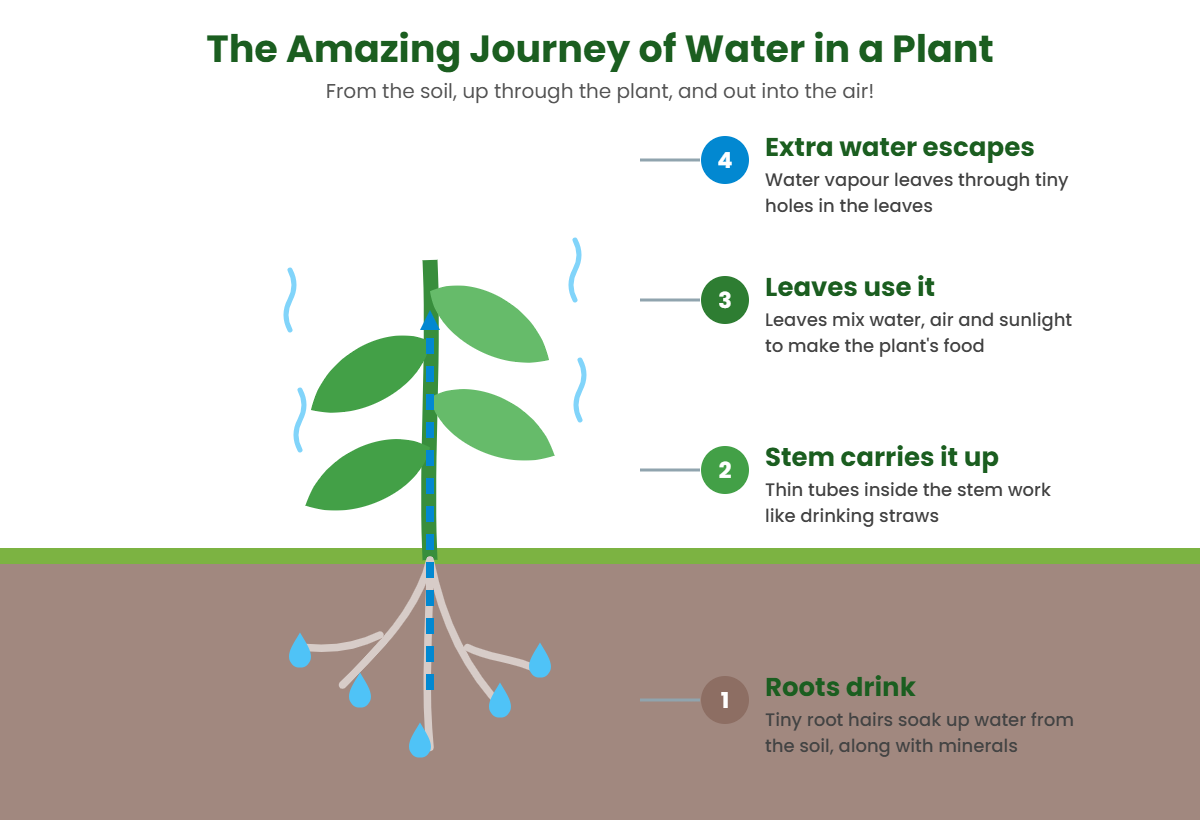
Step 1: Roots drink 🌱
Root hairs soak up water and minerals from the soil.
Step 2: The stem carries it up 🥤
Inside the stem, there are lots of tiny tubes, thinner than a thread. They work just like drinking straws, carrying water upward from the roots to the leaves and flowers.
Think about it: when you drink juice with a straw, the juice goes up the straw. Water goes up the plant’s tiny tubes in a similar way!
Step 3: The leaves use it 🍃
When the water reaches the leaves, something magical happens. The leaves mix water, air and sunlight to cook up food for the plant. That’s right, plants make their own food in their leaves!
Remember? We talked about this plant superpower in From Seed to Plant.
Step 4: Extra water escapes 💨
Leaves have tiny holes, so small you can’t see them without a microscope. Some of the water floats out of these holes as invisible water vapour, a bit like how we sweat on a hot day.
And here’s the coolest part: when water escapes from the leaves at the top, it pulls more water up from the roots at the bottom, like a long chain. That’s what keeps the whole journey moving!
So, How Do Plants “Eat”? 🍽️
Now let’s answer the second part of the big question.
We eat food like rice, chapati and fruits. But plants don’t need to eat food, because they make their own!
Here’s the plant’s “recipe”:
- 💧 Water from the roots
- 🌬️ Air that goes in through the tiny holes in the leaves
- ☀️ Sunlight that falls on the leaves
Mix them together in a green leaf, and you get food for the plant! The plant uses this food to grow taller, make new leaves, and grow flowers and fruits.
And the minerals that came up with the water? They’re like vitamins, helping the plant stay healthy and strong.
So plants:
- drink through their roots,
- carry water through their stem,
- and make food in their leaves.
Clever plants!
Activity: The Colour-Changing Flower! 🌼
Want to see a plant drinking with your own eyes? Try this fun experiment!
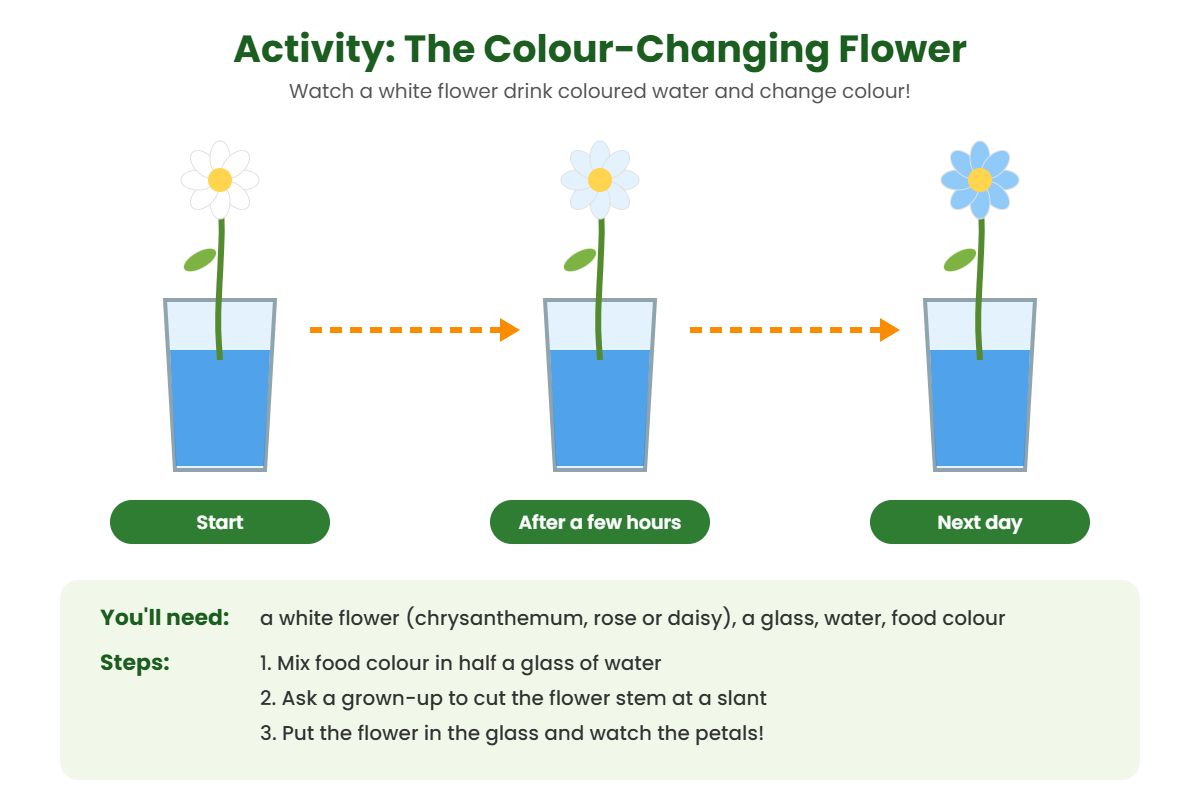
You’ll need:
- A white flower with a stem (chrysanthemum, white rose, or a daisy works well)
- A glass
- Water
- Food colour (blue or red shows up best)
What to do:
- Fill a glass halfway with water and mix in a few drops of food colour.
- Ask a grown-up to cut the end of the flower stem at a slant, so it can drink easily.
- Put the flower in the coloured water.
- Check on it after a few hours, and again the next day.
What happens? The white petals slowly start to change colour! That’s because the flower is drinking the coloured water up through its stem, all the way to the petals. You’re actually seeing the water’s journey!
Try this too: Ask a grown-up to cut the stem lengthwise into two halves. Put one half in blue water and the other in red water. What do you think will happen to the petals?
Bonus Activity: Catch a Plant “Sweating”! 💦
- On a sunny morning, ask a grown-up to help you tie a clear plastic bag loosely around a few leaves of a plant (still growing in its pot).
- Leave it in the sun for a few hours.
- Come back and look inside the bag.
You’ll see tiny water drops inside! That’s the water vapour that escaped from the leaves. Proof that plants really do “sweat”! Remember to remove the bag afterwards.
Quick Quiz! 🧠
- Which part of the plant drinks water? (The roots!)
- What carries water up the plant, like a straw? (Tiny tubes in the stem!)
- Where does a plant make its food? (In its leaves!)
- What three things does a plant need to make food? (Water, air and sunlight!)
A Note for Parents and Teachers
The colour-changing flower is a wonderful way to make an invisible process visible. White chrysanthemums are easy to find in Indian flower markets and change colour beautifully. Use a stronger food colour for faster results. The plastic bag activity is a gentle introduction to transpiration, and children love finding the “sweat” drops.
Little Questions, Big Answers
Do plants drink water through their leaves?
Mostly, no. Plants drink through their roots. Leaves can take in a tiny bit of water, but their main job is to make food and let out extra water vapour.
Why do plants droop when they need water?
Water fills up the plant’s cells and keeps them firm, like air in a balloon. When there isn’t enough water, the cells go soft, and the plant droops.
Can a plant drink too much water?
Yes! If the soil stays wet all the time, the roots can’t breathe and they get sick. Plants need just the right amount, not too much and not too little.
Next Time You Water a Plant…
…think about the amazing journey that water is about to take: soaked up by tiny root hairs, carried up through tiny straws, turned into food in the leaves, and finally floating away into the air.
So the next time someone asks you, “How do plants eat without a mouth?”, you’ll know exactly what to say!
In the next Kids Gardening post, we’ll discover how kitchen scraps turn into plant food: how compost is made.
Did your flower change colour? Ask a grown-up to share a photo in the comments! Watch fun gardening videos on YouTube and follow along on Instagram.