When I was a child, my favourite time of the year was the school vacation. Because every holiday, I went to my village.
Back then, Indian families were big joint families: grandparents, uncles, aunts and lots of cousins, all living together under one roof. There was always someone to play with, and always something to do.
I spent my whole day in the fields with them. I helped graze the cows, walked along the muddy edges of the paddy fields, and even helped with growing paddy. My hands and feet were always covered in soil, and I loved every minute of it!
One of my cousin brothers is a farmer, and there was something he did that fascinated me. He never threw away cow dung or kitchen waste. Instead, he used them to help his crops grow! Peels, scraps and cow dung that most people would call “waste” went back into the soil, and the plants grew strong and healthy.
I wondered: how can waste help plants grow?
I didn’t learn the answer from a book. I learnt it practically, by watching my cousins, asking questions, and doing it with my own hands in the fields. And today, I want to share that same magic with you.
Let’s find out how compost is made!
What Is Compost? 🤔
Compost is what you get when old plant and food scraps, like vegetable peels, fruit skins and dry leaves, slowly break down and turn into dark, crumbly soil.
It doesn’t look like peels anymore. It doesn’t smell like rotten food. It looks and smells like rich, earthy soil, the kind plants love!
Gardeners call compost “black gold”, because it’s like treasure for plants. It’s full of the food they need to grow.
And the best part? Compost is nature’s way of recycling. Nothing is wasted. Everything goes back to the soil.
Who Makes Compost? Meet the Recycling Team! 🦸
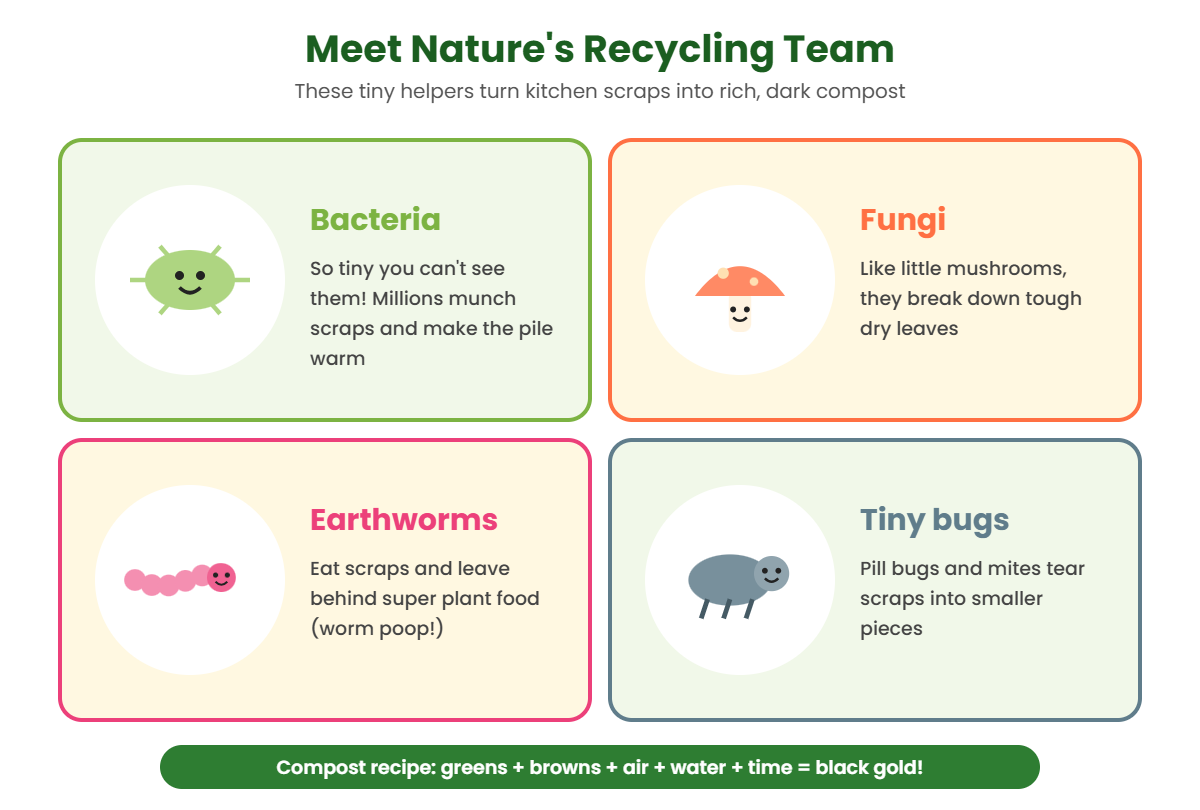
Here’s the big secret: we don’t make compost. Tiny living creatures do!
When we put scraps together, a whole team of tiny helpers gets to work.
🦠 Bacteria, the invisible workers
Bacteria are so tiny you can’t see them, not even with a magnifying glass! But there are millions and millions of them in a compost pile. They munch on the scraps all day and night. They work so hard that the inside of a compost pile can actually get warm!
🍄 Fungi, the leaf breakers
Fungi are like little mushrooms and moulds. They’re great at breaking down tough, dry things like leaves and twigs that are hard for others to eat.
🪱 Earthworms, the super gardeners
Earthworms wiggle through the pile, eating scraps. What comes out the other end (yes, worm poop!) is one of the best plant foods in the world. Gardeners even have a fancy name for it: vermicompost.
🐞 Tiny bugs, the choppers
Little creatures like pill bugs and mites tear scraps into smaller pieces, so the bacteria and fungi can finish the job faster.
Scientists call this team decomposers (say it: dee-kum-poh-zers). That’s a big word for “helpers that break things down.”
The Compost Recipe 🥣
Just like cooking, making compost needs a recipe. Here are the five ingredients:
- 🥕 Greens: Wet, fresh things like vegetable peels, fruit scraps and fresh leaves. They’re like the team’s food.
- 🍂 Browns: Dry things like dry leaves, paper and twigs. They help keep the pile from getting too wet and smelly.
- 🌬️ Air: The recycling team needs to breathe!
- 💧 Water: Just a little, enough to keep everything damp, like a squeezed sponge.
- ⏳ Time: The team works slowly. It takes weeks or even months!
Mix them all together, wait patiently, and slowly, the scraps disappear and turn into dark, crumbly compost.
Why Did My Cousin Use Cow Dung? 🐄
Remember the cows I helped graze during my holidays? Those cows gave the farm something very special, and it wasn’t just milk!
Cow dung is something farmers in India have used for hundreds of years. It’s full of tiny helpers that speed up composting, and it adds food for plants to the soil. When farmers mix cow dung with crop waste and kitchen scraps, it slowly turns into rich manure and compost that makes their fields healthy and fertile.
So farmers were composting long before it became a “trend.” They knew nature’s secret all along!
Activity: Make Compost in a Bottle! 🍾
You don’t need a farm to see compost being made. You can watch it happen in a bottle!
You’ll need:
- A big, clear plastic bottle (ask a grown-up to cut off the top)
- Some garden soil
- Chopped vegetable and fruit peels (no cooked food!)
- Dry leaves
- A spray bottle with water
What to do:
- Ask a grown-up to poke a few small holes in the bottle sides, so air can get in.
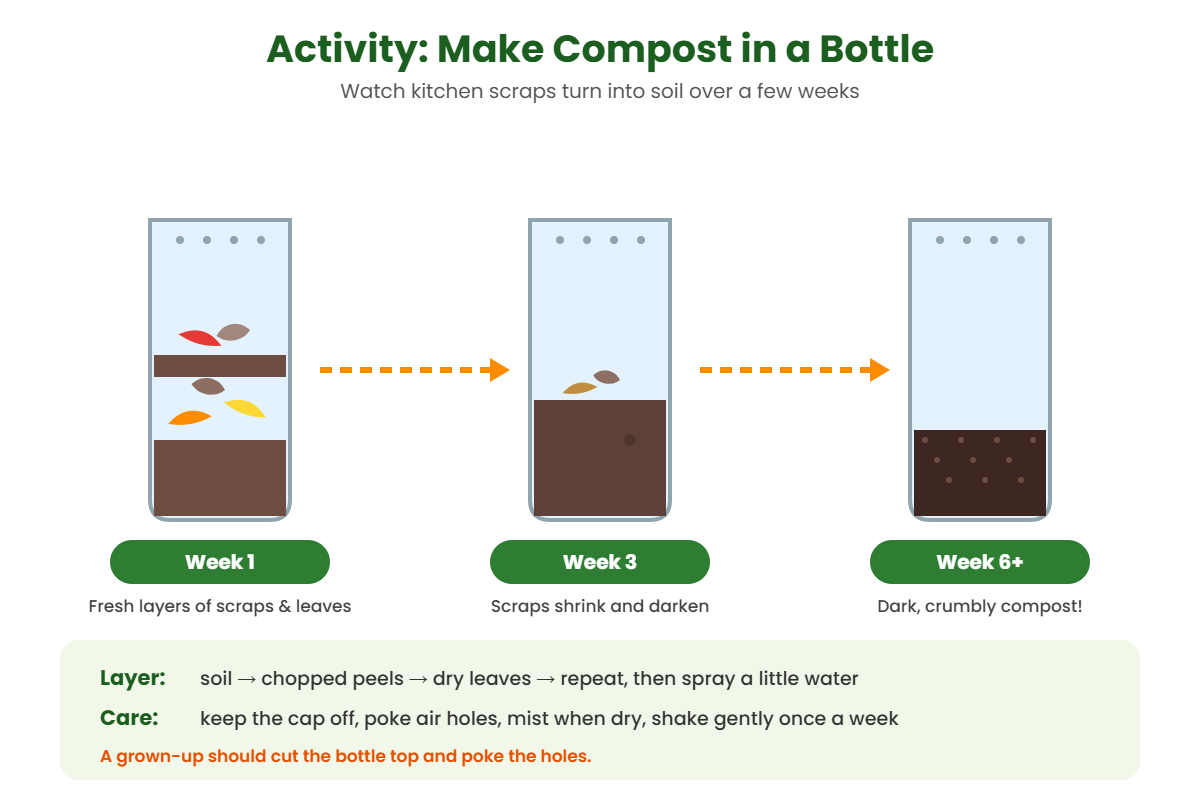
- Put a layer of soil at the bottom.
- Add a layer of chopped peels.
- Add a layer of dry leaves.
- Repeat the layers until the bottle is nearly full.
- Spray a little water on top, so it’s damp but not soggy.
- Keep the bottle in a warm spot, without a cap, and give it a gentle shake once a week.
What you’ll see:
- Week 1: You can clearly see all the peels and leaves.
- Week 3: The scraps start to shrink and turn darker. The recycling team is at work!
- Week 6 and beyond: The layers turn into dark, crumbly compost. You did it!
Be a scientist: Draw what your bottle looks like every week. Which scraps disappear first: banana peel or dry leaves? Write down your guess, then find out!
Remember: Always wash your hands after touching compost.
Quick Quiz! 🧠
- What do gardeners call compost? (Black gold!)
- Who really makes compost? (Tiny decomposers like bacteria, fungi, earthworms and bugs!)
- What are the five ingredients in the compost recipe? (Greens, browns, air, water and time!)
- Should you put cooked food in your compost bottle? (No! Only raw peels and scraps.)
A Note for Parents and Teachers
The compost bottle is a wonderful long-term observation project. It teaches patience, decomposition, and recycling in a way children can see. Use raw vegetable and fruit scraps only, and keep the bottle uncapped with air holes to avoid smells. It’s a lovely way to connect children to traditional village farming practices, like the use of cow dung manure.
For grown-ups who want to compost at home, read my guide on Composting at Home with a Khamba.
Little Questions, Big Answers
How long does compost take to make?
In a bottle, you’ll see big changes in about 6 weeks. In a bigger compost bin, it usually takes 2 to 3 months.
Does compost smell bad?
Good compost smells earthy, like soil after rain. If it smells bad, it’s usually too wet, so add more dry leaves and let air in.
Why is compost good for plants?
Compost is full of plant food, and it makes soil soft and healthy, so roots can grow easily and drink water well.
Waste Is Not Waste!
Those village holidays taught me so much: grazing cows in the morning, working in the paddy fields, and watching my cousin turn “waste” into food for his crops. As a child, it felt like magic.
Now I know it’s not magic. It’s nature’s tiny recycling team, working quietly in the soil. And that lesson from the fields is what I still follow on my terrace today, with my own compost.
So the next time you throw away a banana peel, stop and think: could this become black gold?
In the next Kids Gardening post, we’ll learn how to keep a plant growth journal, your very own plant diary!
Did you make a compost bottle? Ask a grown-up to share a photo in the comments! Watch fun gardening videos on YouTube and follow along on Instagram.